

How to Choose the Right Lithium Battery for AGVs, AMRs, and Mobile Robots
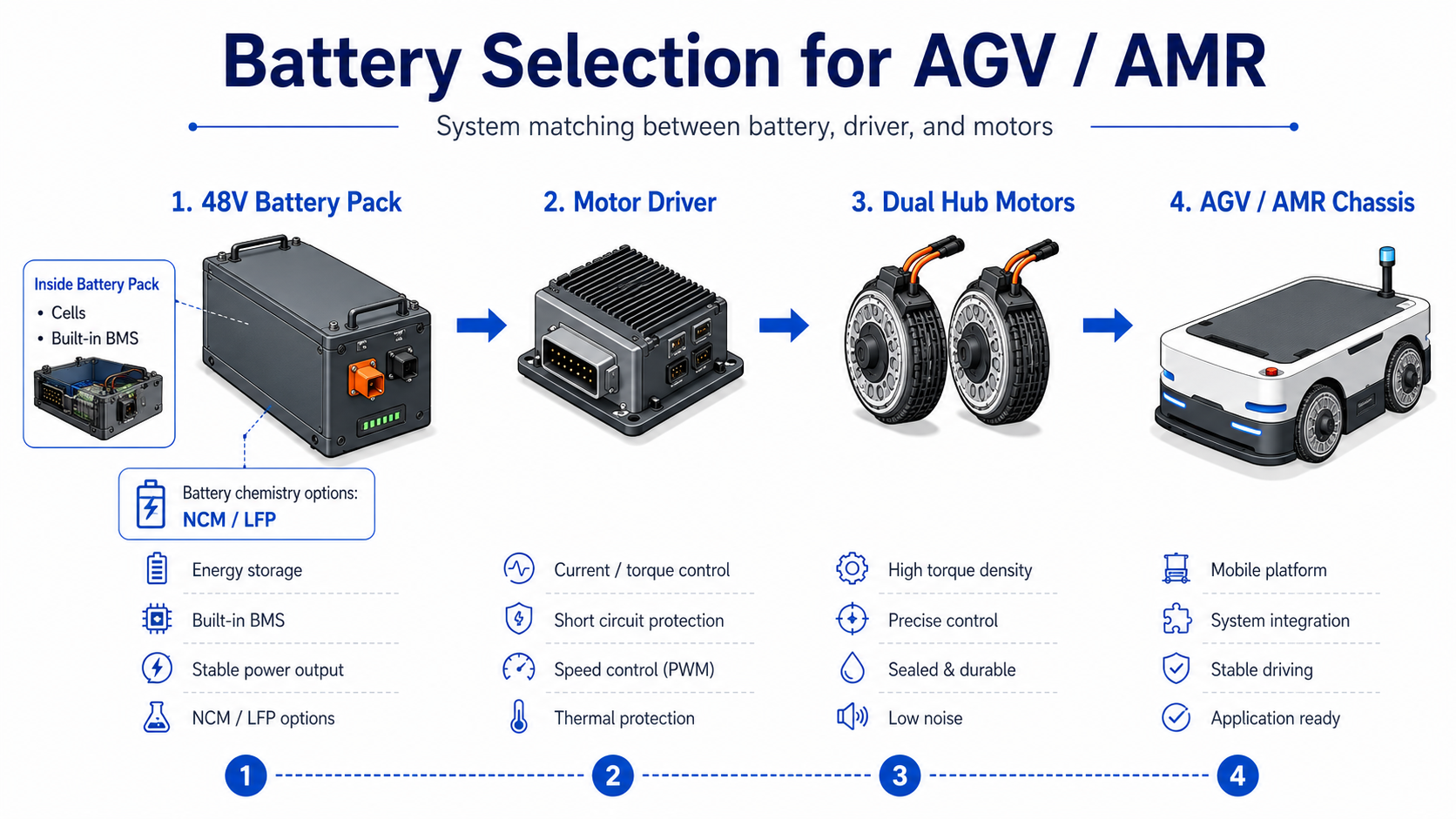
Differences Between Ternary Lithium Batteries and Lithium Iron Phosphate Batteries, and Key Points to Check During Battery Selection
In electric mobile equipment such as AGVs, AMRs, mobile robots, electric transport carts, and small mobility devices, the battery is one of the most important components.
A battery does not only determine “how long the equipment can operate.” In actual applications, it is also closely related to starting performance, acceleration performance, climbing ability, stability under heavy load, and the overall reliability of the system.
However, when selecting a battery, many people first focus on the following points:
“Do we need a 48V battery?”
“Would around 20Ah be enough?”
“What capacity do we need?”
Of course, voltage and capacity are important factors.
However, in actual projects, these alone are not enough.
Even if the capacity appears to be sufficient in theoretical calculations, problems may occur during actual running tests, such as a large voltage drop during startup, BMS protection being triggered, insufficient power when climbing slopes, or a low-voltage alarm from the motor driver.
Therefore, when selecting a battery for a mobile robot, it is necessary to comprehensively check not only voltage and capacity, but also the cell type, discharge capability, BMS specifications, operating environment, and actual working conditions.
1. Basic Structure of a Lithium Battery Pack
A typical lithium battery pack mainly consists of the following components:Battery Pack
│
├── Cells
├── BMS(Battery Management System)
├── Case / Enclosure
├── Wiring / Harness
└── ConnectorsAmong these components, the cell is the core part that actually stores electrical energy.
The quality of the cells directly affects capacity, service life, safety, discharge capability, internal resistance, and the degree of voltage drop.
On the other hand, the BMS(Battery Management System) is the system that manages the entire battery pack. Its main functions include:
・Overcharge protection
・Over-discharge protection
・Overcurrent protection
・Short-circuit protection
・Temperature protection
・Cell balancing
・SOC management
・Communication via CAN / RS485, etc.
In other words, a good battery pack requires not only high-quality cells, but also a suitable BMS and proper structural design for the intended application.
2. What Is a Ternary Lithium Battery?
A ternary lithium battery is a lithium-ion battery that uses nickel, cobalt, and manganese, or nickel, cobalt, and aluminum, as the main materials for the positive electrode.It is commonly represented by the following abbreviations:
NCM
NCA
The major feature of ternary lithium batteries is that they have high energy density and are relatively easy to make lightweight when compared at the same capacity.
Therefore, they are suitable for applications where long operating time or long driving range must be achieved within limited space and weight.
Typical applications include:
・Electric bicycles
・Drones
・Power tools
・Some electric mobility devices
・Small mobile equipment requiring lightweight design
The main advantages of ternary lithium batteries are:
・High energy density
・Easy to reduce weight
・Easy to increase capacity within the same volume
・Suitable for applications with restrictions on weight and space
On the other hand, there are also points that require attention:
・Thermal stability may be lower than that of lithium iron phosphate batteries
・BMS protection design becomes more important
・Cycle life tends to be shorter than that of lithium iron phosphate batteries
・Safety design is important against high temperature, overcharging, impact, etc.
For this reason, ternary lithium batteries are suitable for applications that prioritize lightweight design and high energy density.
3. What Is a Lithium Iron Phosphate Battery?
A lithium iron phosphate battery is a lithium-ion battery that uses lithium iron phosphate as the positive electrode material.In English, it is commonly abbreviated as LFP.
The major feature of lithium iron phosphate batteries is that they offer high safety, long cycle life, and stable long-term use.
Therefore, they are widely used in industrial applications such as:
・AGVs
・AMRs
・Industrial mobile robots
・Electric transport carts
・Forklifts
・Energy storage systems
・Equipment requiring long continuous operation
The main advantages of lithium iron phosphate batteries are:
・High safety
・Excellent thermal stability
・Long cycle life
・Suitable for frequent charging and discharging
・Easy to reduce total cost over long-term use
On the other hand, there are also some points to consider:
・Energy density is lower than that of ternary lithium batteries
・The volume may be larger at the same capacity
・The weight may be heavier at the same capacity
・Dimension confirmation is important when installation space is limited
AGVs, AMRs, and industrial mobile robots are usually required to operate stably not just for a few months, but over several years. Therefore, when safety and service life are important, lithium iron phosphate batteries are a very strong option.
4. Comparison Between Ternary Lithium Batteries and Lithium Iron Phosphate Batteries
| Abbreviation | NCM / NCA | LFP |
| Energy density | High | Slightly lower |
| Weight | Easier to make lightweight | Tends to be slightly heavier |
| Safety | Protection design is important | High |
| Cycle life | Medium | Long |
| Thermal stability | Requires attention | Excellent |
| Main applications | Electric bicycles, drones, power tools, etc. | AGVs, AMRs, transport carts, energy storage systems, etc. |
| Suitable conditions | Lightweight, compact size, long driving range | Safety, long life, stable operation |
In simple terms:Ternary lithium batteries are suitable for applications that prioritize lightweight design and high energy density.
For example, electric bicycles, drones, power tools, and some small mobility devices. These products require longer operating time or driving range within limited volume and weight.
Lithium iron phosphate batteries are suitable for applications that prioritize safety, cycle life, and long-term stable operation.
For example, AGVs, AMRs, industrial mobile robots, electric transport carts, forklifts, and energy storage systems. These types of equipment often operate for long periods and undergo frequent charging and discharging, so a battery system with high safety and long service life is required.
5. Why Battery Selection Should Not Be Based on Capacity Alone
When selecting a battery, the following calculation is commonly used:Wh = V × AhFor example, in the case of a 48V 20Ah battery:
48V × 20Ah = 960WhThis calculation is very important for understanding the energy amount of a battery.
However, for actual operation of mobile robots, this alone is not enough.
This is because mobile equipment does not always operate under constant conditions.
In real operating environments, the following situations occur:
・Startup
・Acceleration
・Deceleration
・Turning
・Climbing slopes
・Passing over small steps
・Heavy-load operation
・Frequent stopping and restarting
・Changes in floor resistance
・Low-temperature environments
・Battery aging
In these situations, the motor may temporarily require a large current.
Therefore, if the battery is selected only based on theoretical average power consumption, the battery output capability may be insufficient during actual operation.
6. Continuous Discharge Current and Peak Discharge Current Are Important
When selecting a battery for a mobile robot, the following two points are especially important:・Continuous discharge current
・Peak discharge currentContinuous discharge current refers to the current that the battery can output continuously for a long period.
Peak discharge current refers to the maximum current that can be output temporarily during startup, acceleration, climbing slopes, and similar conditions.
For example, if one device uses two 48V motors and each motor has a rated current of 10.5A, the total current during rated operation of the two motors is:
10.5A × 2 = 21AIn this case, if the battery’s continuous discharge current is around 20A, there is already almost no margin.
In actual design, it is necessary to provide a larger discharge margin by considering startup, acceleration, slope climbing, floor resistance, battery aging, and other factors.
Furthermore, during startup or slope climbing, the instantaneous current may reach 40A, 50A, or even higher.
If the peak current setting of the BMS is too low, the BMS may activate overcurrent protection and stop the equipment, even when battery capacity still remains.
In other words, capacity determines “how long the equipment can operate,” while discharge capability determines “whether the load can actually be driven.”
7. Checking BMS Specifications Is Also Important
A BMS is not just a protection board.In mobile robots and AGVs, it is an important component that greatly affects system stability.
When selecting a battery, it is important to check the following items:
・Maximum continuous discharge current
・Maximum peak discharge current
・Overcurrent protection value
・Over-discharge protection value
・Temperature protection range
・Cell balancing function
・CAN / RS485 communication support
・Whether SOC, voltage, current, and fault information can be outputEspecially in AGVs and AMRs, the upper-level controller may acquire battery level and fault information to determine automatic return-to-charging or emergency stop.
Therefore, depending on the system requirements, it is preferable to select a smart BMS with communication functions.
8. Why Battery Design Should Be Larger Than Theoretical Values
In actual engineering design, it is not recommended to select a battery that only just meets the theoretical value.Theoretical calculations are often based on ideal conditions:
・Flat floor surface
・Constant speed
・Standard temperature
・New battery
・No additional load
・No frequent start-stop operationHowever, in actual operating environments, these conditions are not always met.
Mobile robots are affected by various factors such as startup, acceleration, turning, slope climbing, steps, heavy load, low temperature, and battery aging due to long-term use.
In addition, battery capacity decreases over time, and internal resistance also changes.
Even if the equipment operates normally when the battery is new, after six months or one year, voltage drop may become larger and the motor driver may trigger an alarm.
Therefore, when selecting a battery for a mobile robot, it is important to provide appropriate margins in capacity, continuous discharge current, and peak discharge current.
9. Why Electric Bicycle Batteries May Not Be Suitable for Mobile Robots
Electric bicycle batteries are generally mature products and are very convenient for daily use.However, this does not necessarily mean that they can be directly used for mobile robots or industrial mobile equipment.
In the case of an electric bicycle, human pedaling force is also applied.
In other words, the motor mainly works as an assist system.
On the other hand, in mobile robots and electric transport carts, the motor must directly drive the vehicle body weight and payload.
In addition, the following severe operating conditions may occur:
・Startup under load
・Low-speed, high-torque operation
・Frequent starting and stopping
・Load fluctuation during turning
・Long continuous operation
・Climbing slopes or passing over stepsTherefore, even if an electric bicycle battery appears to have sufficient capacity, it may not operate stably in a mobile robot due to BMS output current limitation, insufficient peak current, voltage drop, and other factors.
When using a battery for a mobile robot, the following items must always be checked:
・Whether the battery voltage matches the system
・Whether the BMS continuous output current is sufficient
・Whether the BMS peak output current is sufficient
・Whether voltage drop under load is within the allowable range
・Whether the cells are suitable for high-load discharge
・Whether excessive heat is generated during long-term operation10. Checklist for Selecting Batteries for Mobile Robots
When selecting a battery for an AGV, AMR, or mobile robot, we recommend checking the following items in order.First, confirm the equipment-side conditions:
・Total equipment weight
・Maximum payload
・Maximum speed
・Maximum climbing angle
・Wheel diameter
・Number of drive wheels
・Whether frequent start-stop operation is required
・Whether on-the-spot turning is required
・Operating environment
・Target operating timeNext, confirm the motor and driver specifications:
・Motor rated voltage
・Motor rated current
・Motor rated output
・Motor peak current
・Driver maximum current
・Driver minimum operating voltage
・Availability of communication and braking functionsBased on these conditions, determine the battery-side specifications:
・Battery voltage
・Battery capacity
・Continuous discharge current
・Peak discharge current
・Charging method
・BMS protection settings
・Communication method
・Dimensions and mounting method
・Waterproof, dustproof, and vibration-resistant requirements11. Select the Battery Type According to the Application
Ternary lithium batteries and lithium iron phosphate batteries each have their own characteristics.Neither is absolutely superior to the other. It is important to select the battery type according to the application.
If lightweight design, compact size, and high energy density are important, ternary lithium batteries may be suitable.
On the other hand, if safety, cycle life, and long-term stable operation are important, lithium iron phosphate batteries may be suitable.
Especially for applications such as AGVs, AMRs, and industrial mobile robots that operate for long periods and repeat frequent charging and discharging, lithium iron phosphate batteries are a strong candidate.
12. Summary
Battery selection for mobile robots, AGVs, and AMRs is not simply a matter of choosing a battery with a certain voltage and capacity.In practice, it is necessary to comprehensively check the following items:
・Whether the voltage matches the system
・Whether the capacity satisfies the required operating time
・Whether the continuous discharge current is sufficient
・Whether the peak discharge current is sufficient
・Whether the BMS protection and communication functions are suitable
・Whether the cell quality and type match the application
・Whether dimensions, mounting method, and operating environment are suitable
Ternary lithium batteries are suitable for applications that prioritize lightweight design and high energy density.
Lithium iron phosphate batteries are suitable for applications that prioritize safety, long service life, and long-term stable operation.
The important point is not to judge only by catalog capacity.
For mobile robots, it is necessary to consider startup current, climbing load, voltage drop, BMS protection, temperature changes, battery aging, and other factors, and to select a battery with sufficient margin for the actual operating environment.
Voltage determines compatibility with the system.
Capacity determines operating time.
Discharge current determines whether the load can be driven.
The BMS supports stable operation.
And the quality of the cells determines the battery’s service life and reliability.
A truly suitable battery for AGVs, AMRs, and mobile robots is not simply a battery that “seems sufficient” based on theoretical values, but one that can operate safely, stably, and for a long period of time in the actual operating environment.
If you have any questions regarding motor selection or battery specifications during development, please feel free to contact us.